

One of the most confusing parts of healing is realizing you keep ending up around the same type of person.
This happens even when you swear you are making different choices.
You tell yourself this relationship will be healthier, or this person is nothing like the people who hurt you before.
Yet somehow, the story often ends in a familiar place.
You find yourself questioning your instincts and wondering why you keep attracting narcissists into your life.
What makes this pattern so difficult to recognize is that narcissists rarely seem dangerous in the beginning.
They often feel familiar, magnetic, charismatic, or intensely connected.
Sometimes they even feel safe.
This is because of what your nervous system learned early in life.
That attraction is not always about desire. Sometimes, it is about recognition.
If you grew up with narcissists, your brain learned to adapt to unhealthy dynamics before you even had the language to understand them.
What feels familiar can easily be mistaken for what feels right.
Many survivors eventually discover that they were not attracting narcissists because they wanted dysfunction.
They were being pulled toward patterns their nervous systems had been trained to survive.
Table of Contents
7 Childhood Patterns That Keep Pulling You Toward Narcissists

1. Red Flags Feel Like Home
Children do not have the ability to step back and objectively evaluate the environment in which they grow up.
Whatever happens inside the home becomes their version of normal.
In narcissistic families, the family system often protects the people causing harm instead of the child being harmed.
Cruel behavior gets excused, accountability disappears, and anyone who challenges the dysfunction becomes the problem.
My toxic mother‘s insults were never called cruelty. They were stress, or discipline, or just the way she was.
My sister was the golden child. She was protected, favored, and held to a different standard entirely.
Meanwhile, my younger brother rarely faced the same consequences I did.
And when I reacted to any of it, no one asked what was wrong with the situation.
They asked what was wrong with me.
Over time, the nervous system learned to adapt instead of resist.
As an adult, controlling behavior may not immediately register as a warning sign because it resembles what you already know.
Criticism can feel familiar rather than alarming.
Manipulation may feel uncomfortable, but not unfamiliar.
When red flags were present throughout childhood, they stopped looking like red flags.
They simply look like relationships.
2. Love Had to Be Earned
Healthy love is freely given.
Children should never have to prove they deserve care, affection, or belonging.
In narcissistic families, however, love often comes with conditions attached.
Approval may depend on achievement, obedience, or the ability to meet someone else’s expectations.
Many children learn very early that being themselves is not enough.
Instead of receiving unconditional acceptance, they spend years trying to earn scraps of validation.
I was born into disappointment, or at least, that was what I was made to feel.
My toxic sibling was the standard I was always measured against, a constant reminder of how much I fell short.
I grew up not just feeling compared, but believing I had to earn my place in the family just to belong.
That belief rarely stays in childhood.
It follows survivors into adulthood and quietly shapes the relationships they choose.
People who experienced conditional love often find themselves attracted to people who make love feel like a test.
Instead of seeking partners who offer consistency, they become drawn to toxic relationships where approval feels uncertain.
The chase becomes familiar.
The effort feels normal.
The emotional highs and lows feel meaningful because they resemble the love they spent years trying to earn.
What they are often seeking is not love itself but the resolution of an old wound that never healed.
3. Limits Were Called Selfish

Healthy families teach children that boundaries are normal and necessary.
Narcissistic families teach the opposite.
In these environments, saying no can be treated as betrayal.
Protecting yourself may be labeled as selfishness, and creating distance can be interpreted as disrespect.
There was a time I said no to giving money I did not have and to showing up when I needed to protect my own peace.
Then I was called selfish, ungrateful, and cold simply for drawing a line.
Over time, the message becomes clear.
Good people sacrifice, loyal people tolerate, and family means accepting whatever treatment is given.
When children receive this message repeatedly, they learn to distrust their own limits.
They ignore the discomfort that would normally warn them that something is wrong.
As adults, people who push boundaries can feel strangely familiar as their entitlement matches what the nervous system learned to expect.
Meanwhile, emotionally healthy people who respect boundaries may feel confused at first.
This is because they do not pressure, guilt, or demand access to every part of your life.
What once felt distant is often what safety actually looks like.
4. You Were Taught to Distrust Yourself
One of the most damaging things a narcissistic family can take from a child is trust in their own perception.
Gaslighting teaches children that their memories, emotions, and experiences cannot be trusted.
When a child repeatedly hears that events did not happen the way they remember, they begin to question their own reality.
My mother could say something cutting and, minutes later, look at me as if I had invented it.
The insult never happened. My hurt, however, was very real, and somehow, that became the issue.
Over time, confusion replaces confidence.
This pattern often continues long after childhood ends.
Family members may twist events and create alternative narratives that protect themselves from accountability.
Many survivors enter adulthood with an internal voice that constantly questions itself.
“Maybe I’m overreacting.”
“Maybe I misunderstood.”
“Maybe it’s my fault.”
Manipulators thrive when someone has been conditioned to second-guess themselves.
This is because they simply repeat the same tactics that already worked in childhood.
5. Chaos Was Mistaken for Connection
Children adapt to the emotional environment in which they grow up.
If home is unpredictable, unpredictability starts to feel normal.
In narcissistic households, affection, anger, criticism, and silence often arrive without warning.
A child never knows which version of a parent they will encounter from one moment to the next.
Some mornings, my mother was warm.
But by evening, the temperature had shifted, and we felt it before she ever said a word.
In public, she was charming and composed. At home, she was someone else entirely.
I became good at reading the signs: her tone, her silence, the way she moved through a room.
Living in this state creates constant tension in the nervous system.
Over time, calm can begin to feel unfamiliar.
The absence of drama may even feel uncomfortable.
As adults, survivors often mistake emotional intensity for emotional intimacy.
Relationships filled with uncertainty can feel exciting because they recreate the emotional atmosphere of childhood.
Meanwhile, healthy relationships may seem boring simply because they are predictable.
The truth is that peace and connection often look very different from what a narcissistic family taught you.
A relationship does not have to be dramatic to be meaningful.
It does not have to be painful to be real.
6. You Were Trained to Carry What Wasn’t Yours
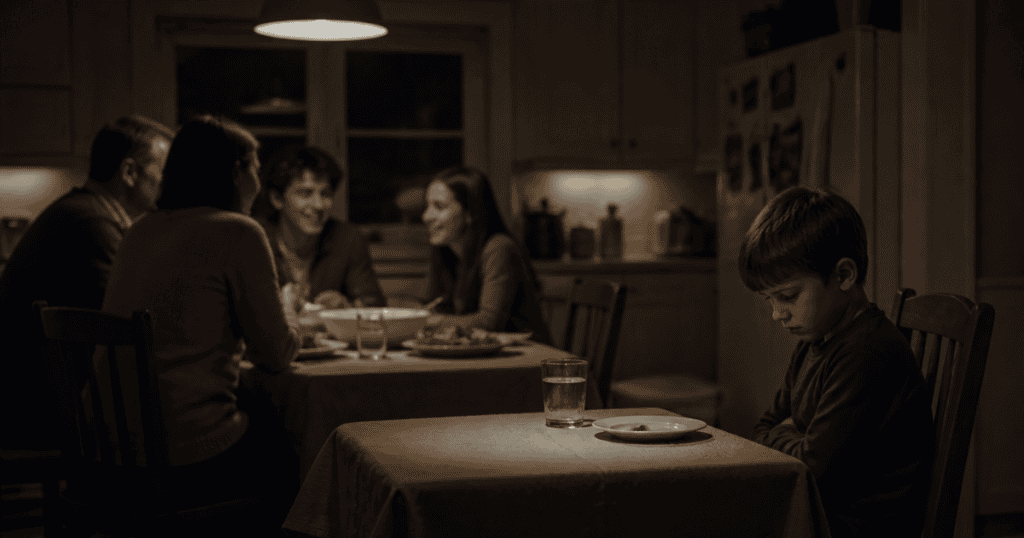
Children in narcissistic families are often assigned roles that have little to do with who they actually are.
One of the most common roles is becoming responsible for everyone else’s emotions, mistakes, and problems.
This burden falls especially hard on the scapegoat child.
The scapegoat becomes the person blamed when things go wrong, even when they had nothing to do with the problem.
When something went wrong, the blame had a way of finding me.
My mother walked away clean, my sister was excused, and my toxic brother faced no consequences.
I was the one who answered for everything.
Over time, this becomes second nature.
Instead of asking who is responsible for a situation, survivors automatically assume responsibility themselves.
They explain away hurtful behavior and make excuses for people who refuse to change.
Many survivors become so accustomed to carrying other people’s emotional weight.
Because of this, they feel guilty whenever they choose themselves.
Peace can feel selfish.
Distance can feel cruel.
Protecting their own well-being can feel like abandonment.
Narcissists are naturally drawn to those who have been trained to overfunction because it allows them to underfunction.
The relationship becomes unbalanced from the start.
One person carries the emotional labor while the other avoids accountability.
7. Having Needs Was Treated Like a Problem
Every child deserves comfort, protection, guidance, and care.
In narcissistic families, those needs are often treated as inconveniences.
A child asking for support or expressing pain may be ignored and even mocked.
The lesson becomes deeply ingrained.
Your needs are too much.
Your feelings are a burden.
You should handle everything yourself.
My narcissistic mother did not mother me, not in the ways that mattered.
It was my father who offered gentleness, and my cousins who made me feel like I belonged somewhere.
The care I was supposed to receive from her came in pieces, from people who were never meant to carry that role.
Many survivors become fiercely independent while secretly longing for care.
They are comfortable meeting everyone else’s needs but uncomfortable expressing their own.
They tolerate relationships where their feelings are ignored because that treatment feels familiar.
When someone offers genuine support, they may even struggle to receive it.
What Starts Changing When You Stop Calling Familiar Safe

Healing from narcissistic abuse often begins with a different question.
Instead of asking why you attract narcissists, you begin asking what feels familiar about the people you are attracted to.
That shift changes everything.
You stop focusing solely on chemistry and start paying attention to patterns.
You notice the boundary-pushing that once seemed harmless, and the emotional confusion that leaves you questioning yourself.
Most importantly, you stop dismissing discomfort just because it feels familiar.
There came a point when I stopped waiting for things to change.
I cut off contact with my sister and stepped away from the family dynamics that had shaped so much of my life.
I stopped defending my reality to people who had already decided what it was.
For the first time, I chose peace because I finally believed I deserved it.
These choices are often painted as selfish by people who benefited from your lack of boundaries.
In reality, they are acts of self-respect.
Every time you choose peace over chaos, your nervous system learns something new.
Every healthy boundary teaches your brain that safety does not require self-sacrifice.
Every relationship built on mutual respect helps rewrite old patterns.
Healing is not about becoming perfect at spotting narcissists.
It is about learning to trust yourself enough to leave when something feels wrong.
You Were Trained Into This, But You Are Not Trapped in It

The conditioning runs deep because it began before you had the words to understand what was happening.
You adapted to survive the environment you were given, and those survival skills protected you then.
But they do not have to define the rest of your life.
I have a chosen family now, a peaceful home, and a husband who shows me what respect looks like.
I have a son who’s growing up with the safety I never had, a life no longer built around eggshells.
Narcissists may have felt like home because of what you survived.
Healing is learning that familiar and safe are not the same thing.
Once you know the difference, everything begins to change.
Related posts:
- 5 Dark Reasons Narcissistic Parents Choose One Child to Destroy
- Shattering Childhood: 8 Hurtful Things My Toxic Parents Often Say
- How to Reclaim Your Adult Identity After Growing Up in a Narcissistic Family
- How I Reparented Myself After Leaving My Narcissistic Family (And Finally Felt Safe in My Own Skin)
- 5 Negative Narcissistic Family Cycles That I Will NOT Continue With My Son