
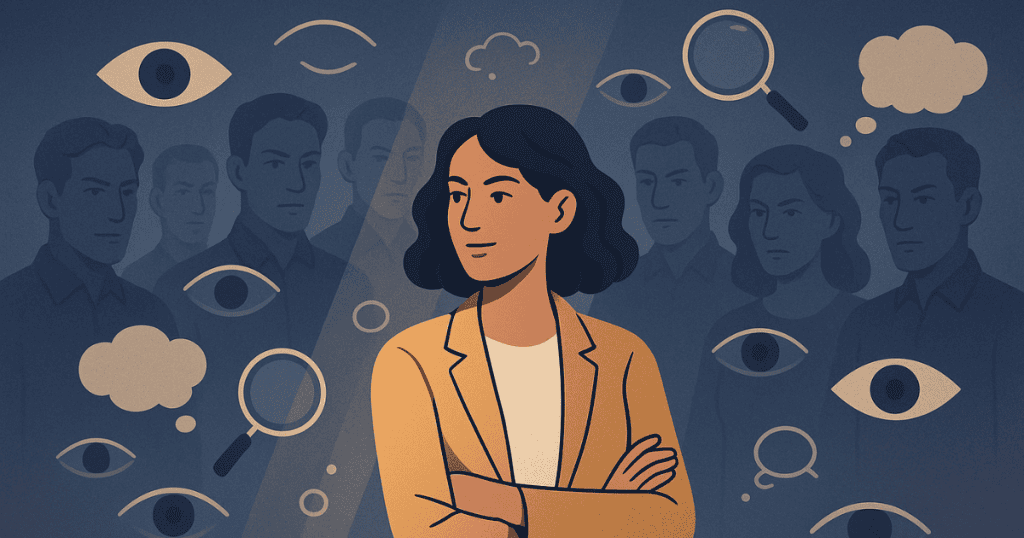
A narcissist doesn’t need you to speak to know who you are. They read you the way a predator studies prey.
I remember walking into my mother’s kitchen one afternoon, grocery bags still in hand.
Before I even set them down, I felt her eyes glide over me like a scanner.
My hair wasn’t brushed “right,” the slump in my shoulders betrayed how tired I was, and the speed of my steps gave away my mood.
She hadn’t spoken, yet I could already sense the judgment simmering beneath her stillness.
That’s the unsettling truth about narcissists: they don’t wait for words.
They read everything. Your body language, your tone, even the way you breathe when you enter their space.
My younger brother once said I was “too easy to read,” and at the time, I didn’t understand how he meant it as a weapon.
Now I do.
Narcissists operate like chess players.
They study you like their opponents: watching, calculating, waiting for you to reveal your weaknesses through the smallest moves.
But once you learn to see the game, once you recognize their scanning habits, you stop being prey.
You flip the board.
Table of Contents
7 Subtle Signals Narcissists Scan Before You Even Speak

Narcissists don’t need a conversation to know your vulnerabilities. They gather information the way hunters track patterns.
Here’s how I learned it the hard way and how you can reclaim control.
1. Your Entrance
When I walked into my toxic sister’s living room after a long day, she never looked at me the way most people look at family.
She wasn’t happy to see me. She was assessing me.
Her eyes darted from my shoes to my hair, then lingered on my face.
If I entered with rushed movements and nervous energy, she would sharpen her tongue and mockingly ask, “Rough day?”
Then followed with a cutting remark that proved she had clocked my exhaustion before I even opened my mouth.
The day I learned to walk in calmly with shoulders back, movements steady, and no nervous apology in my body language, everything shifted.
She hesitated.
For once, she didn’t know where to strike.
My calm entrance robbed her of the instant ammunition she normally collected.
Think of your entrance as setting the first move in chess.
Calm equals control.
2. Your Gaze

I’ll never forget being trapped in the car with my narcissistic brother on a road trip.
He kept flicking his eyes toward me in the rearview mirror, not out of care, but challenge.
He wanted me to break eye contact. To look away first. To silently admit defeat.
When I finally dropped my gaze to my phone, I caught the smirk on his face.
It was a quiet triumph, as though he had extracted power without a single word. That tiny exchange haunted me later.
I began practicing steady, relaxed eye contact. Not glaring, not challenging, just an unflinching presence.
The next time he tried the same trick, I held his gaze in the mirror without blinking, then calmly turned my attention back to my book.
His smirk never came as he had no wins to collect.
Your gaze is your shield. Break it too soon, and they’ll read it as surrender.
3. Your Hands
During one of my manipulative mother’s “budget talks,” I caught myself nervously spinning a pen between my fingers.
At the time, I thought it was harmless, just something to do.
But later, I realized she had zeroed in on it.
My restless hands told her I was uncomfortable, which meant she could push harder. And she did.
That’s the danger of unconscious movements: they betray emotions we’re trying to hide.
Narcissists live for that.
My sister once called me out during a simple chore, saying, “Why are your hands shaking? Guilty about something?”
She wasn’t seeking the truth. She was twisting perception.
Now, I control my hands deliberately.
A calm sip of water, resting them flat on the table, or keeping them still in my lap, these small changes project strength.
They tell my family, “You won’t find your opening here.”
Your hands are like secret tell cards. Control them, and you keep the game in your favor.
4. Your Pace

My toxic sister once asked me to bring her coffee while she worked on her laptop.
I rushed down the hall like a servant, spilling a bit on the saucer in my panic to please her.
She didn’t thank me. Instead, she mocked me for being “clumsy.”
That was the moment I realized that rushing equals submission. Speed shows fear.
When I began moving with deliberate slowness, something remarkable happened. She shifted in her chair, irritated.
Narcissists don’t know how to handle calm, controlled pacing.
It denies them the satisfaction of your frantic compliance.
Now, even in tense conversations, I walk slowly, sit deliberately, and refuse to let their urgency control my movements.
The effect is subtle but powerful: they look more anxious than I do.
Your pace is your tempo. Move slowly, and you conduct the rhythm of the room.
5. Your Smile
Family photos used to be my prison.
My toxic mom would instruct me to “smile bigger,” and I obeyed, stretching my mouth until my cheeks hurt.
Later, those forced smiles became evidence she wielded against me, “See? You were always happy with us.”
But I wasn’t.
My smile was survival, not joy.
One day, in a cousin’s kitchen, she made the same command.
Instead of plastering on the mask, I gave a small, genuine smile on my own terms.
The silence that followed was louder than any insult. She realized she no longer controlled my face.
Narcissists exploit people-pleasers.
A forced smile is a surrender. A real smile, the one you choose, when you choose, is power.
Your smile is currency. Spend it on your terms, not theirs.
6. Your Listening

I remember sitting at the dining table, trying to finish some paperwork, when my self-absorbed sister plopped down across from me.
Without even asking if I was busy, she launched into a detailed story.
She said everyone at work was “jealous of her” and that she always had to deal with “incompetent people.”
I thought being a good sister meant showing support, so I leaned in and nodded too much.
I added little phrases like, “Wow, that must be so hard,” or “I know exactly what you mean.”
I even slipped in one of my own frustrations, thinking it would make her feel less alone.
Later, during an argument, she threw my words back at me.
She said, “You’re the one who said you can’t even keep up with your own responsibilities. Don’t blame me for your stress.”
That was the moment I realized that my listening wasn’t neutral. It was giving her tools to cut me down.
Now, I keep my responses minimal. A calm “hmm” or silence is enough.
I don’t fill the space with nervous laughter or oversharing.
And when I stopped feeding her with reactions, she started tripping over her own stories.
Listening is like handing over a microphone. Keep it short, keep it calm, and they run out of script.
7. Your Exit
I used to leave family gatherings like a ghost. Quiet, head down, muttering a quick “bye.”
By the time I got to my car, I felt erased, like I hadn’t mattered at all.
That invisibility was exactly how they wanted me to feel.
One afternoon at my aunt’s house, I tried a new tactic.
When I decided to leave, I stood tall, gathered my things without rushing, and said my goodbye clearly.
I walked to the door without shrinking.
The silence that followed was thick. They weren’t used to me owning my exit.
Exiting with presence leaves a mark narcissists can’t control. You stop being the shadow they erase and become the imprint they can’t ignore.
Your exit is your final move. Leave like a player, not prey.
What You Lose When You Don’t See Their Game?

For years, I didn’t notice any of this.
I thought my rushed steps, nervous hands, and forced smiles were invisible.
They weren’t.
Every twitch and hesitation was data my narcissistic family used against me.
The cost? Years of shrinking into someone I barely recognized.
My narcissistic mother painted me as fragile. My toxic siblings painted me as clumsy and weak.
And because I didn’t understand their scanning game, I believed them.
Failing to notice these cues means living in a world where you’re constantly read but never truly seen.
Flip the Script and Learn to Read Narcissists First

Here’s the truth that flipped everything for me: narcissists aren’t unpredictable. They’re patterned.
The day I caught my mother sighing dramatically, waiting for me to ask, “What’s wrong?” I didn’t bite.
I watched her instead.
For the first time, I wasn’t the one being studied. I was the one studying.
That moment felt like reclaiming stolen territory. I had shifted from being prey to being a strategist.
It didn’t stop her behavior, but it stopped my automatic submission.
When you learn to read them back, it means you’re prepared.
You become the chess player, not the pawn.
When You’re No Longer Easy to Read, You’re Dangerous

The first time I kept my body still, my gaze steady, and my movements slow, my sister muttered under her breath, “What’s gotten into you?”
That’s when I knew the balance had shifted.
Recognizing these seven cues doesn’t just make you harder to read, but impossible to own.
You stop walking through life as a watched object and start walking as an unshakable presence.
For me, this awareness brought something I never thought I’d feel in my narcissistic family: peace.
They didn’t stop trying to scan me, but I stopped giving them access.
And that single shift gave me back my dignity.
They may read you, but they’ll never own you once you learn to read them back.
Related posts:
- 5 Simple Tests to Spot a Narcissist Before They Wreck Your Sanity
- 9 Subtle Boundaries That Send a Narcissistic Gaslighter Into Total Meltdown
- 5 Dirty Secrets a Narcissist Will Take to the Grave (But You Can Exploit)
- The One Personality Type Narcissists Can’t Outsmart (And Why They Always Lose)
- 7 Phrases I Used to Put My Narcissistic Family In Their Place Without Raising My Voice